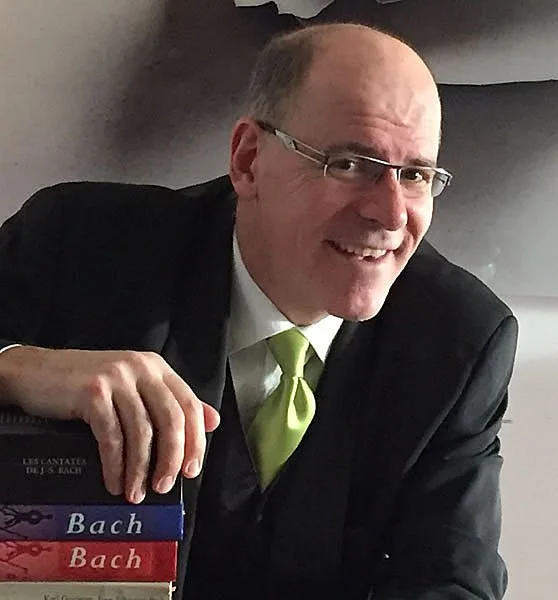
François Panneton
Conductor 1997-2023
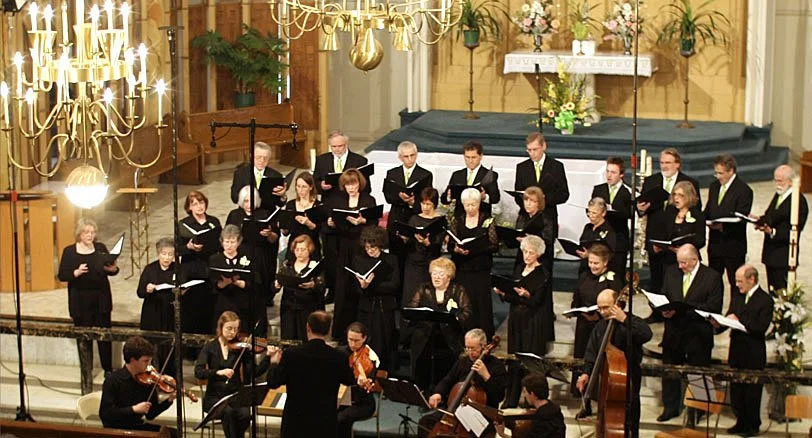
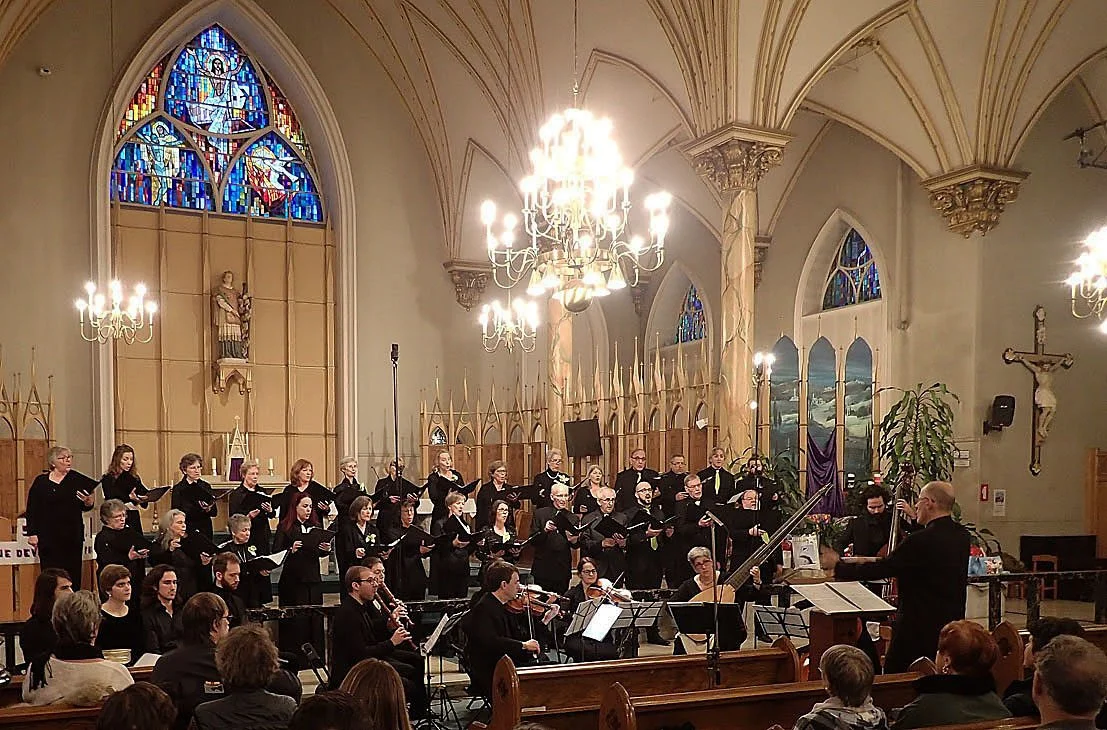
L’ensemble vocal Bach et Baroque, known until the fall of 2015 as L’ensemble vocal Les Beaux Regards, was born in the autumn colours of early October 1997, following a meeting between Manon Beauregard, who was working at the Workers' Compensation Board at the time, and François Panneton, a choir director. Manon was responding to a call from Centraide, which was launching its fundraising campaign. The choir was formed, and its very first concert was the song “Donnez, donner, ça fait du bien” (Give, give, it feels good), which was the theme song for the Centraide campaign that year (duration, two minutes). How far they've come since then!
During his tenure as conductor, the choir performed many of his own choral arrangements of vocal and instrumental works. In 2024, François Panneton was named an Honorary Member of the choir.
An article about François Panneton appeared in the magazine “Chanter” in March 2024.
Past Concerts
Spring 1998 : Jazz and Barbershop quartets
With piano.
Making a remarkable entrance into the world of live performance, Les Beaux Regards presented several jazz standards in a one-hour concert: Summertime, Moonglow, Everytime We Say Goodbye…
Spring 1999 : Schubert
With piano.
Some of Schubert's most beautiful Romantic vocal works delighted the audience at this piano concert, most of them sung in French.
Spring 2000 : Love through the Ages
With piano.
Through a grand journey through time, a selection of music dedicated to love was on the program: from Monteverdi's madrigals to the provocative music of Kurt Weill, by way of German cantatas and great arias from Baroque, Classical, and Romantic operas, the ensemble charmed the audience and demonstrated its ability to sing in all styles.
Spring 2002 : A History of Baroque Music
With string orchestra.
The loyal audience of Les Beaux Regards was invited on a true European journey. From Monteverdi's nascent opera to the exuberant music of Bach and Handel, listeners could experience the great revolution brought about by the Italians at the beginning of the 17th century, who paved the way for modern music, particularly through the influence of their two greatest inventions: the concerto and the opera.
December 2002 : Christmas Concerts
Among the many Christmas concerts presented by the ensemble, there were in particular two performances at the Château Ramezay and the Palais des Congrès in Montreal.
Spring 2003 : Erotic Madrigals and Night Songs
With string orchestra and piano.
On Saturday and Sunday, June 7 and 8, Les Beaux Regards presented a double bill: Claudio Monteverdi's erotic madrigals were followed in the second half by Franz Schubert's Nocturnal Songs, with love as the central theme.
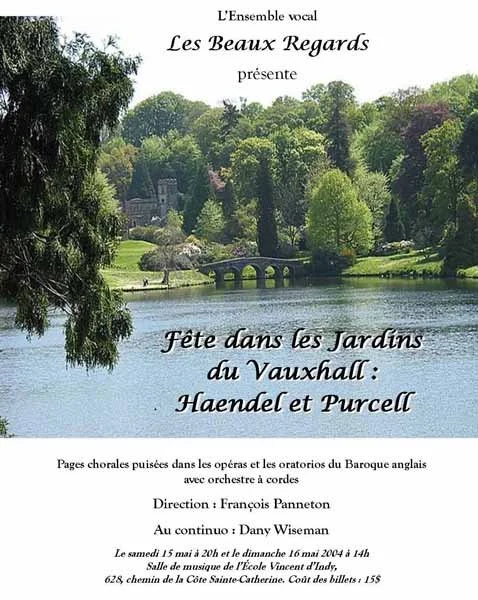
Spring 2004 : Celebration in the Vauxhall Gardens
With string orchestra.
The vocal ensemble Les Beaux Regards presented some of the most beautiful pieces by Handel and Purcell during this concert, as they might have been heard in the gardens of Vauxhall in the first half of the 18th century. A few titles: Purcell's "Come ye sons of art, Rejoice in the Lord always"; Handel's "O Lord, how dark are thy decrees, As with rosy steps, Amen."
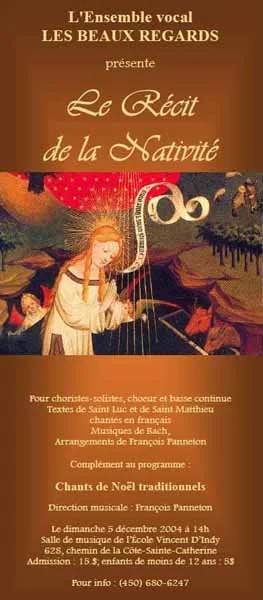
December 2004 : The Nativity Story
Why a Nativity Story, why Bach? First, Bach wrote some thirty cantatas for the Christmas season, containing many gems. The primary goal was undoubtedly to introduce this extraordinary music to the Beaux Regards and our loyal audience in a coherent work. The second was to provide the choir with a clear, primarily vocal score in French, with a reasonable technical challenge. The third was to experience intensely the Nativity story, as recounted by Luke and Matthew, so moving, which has stayed with us since childhood and continues to stir our sense of wonder. Thanks to everyone's remarkable work, all goals were achieved!
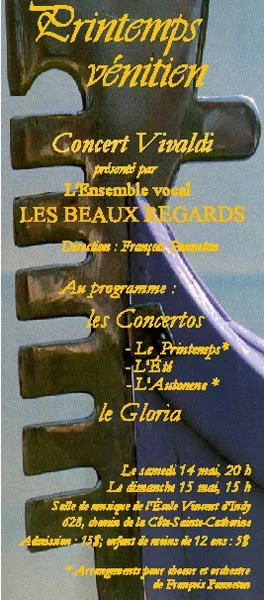
Spring 2005 : Vivaldi : Spring and Autumn Concertos; Gloria
With string orchestra.
Vivaldi’s Four Seasons concertos are known to all. These brilliant and virtuosic works exude unparalleled fantasy, verve, and vitality. But be warned: Vivaldi composed them based on short, picturesque poems that provided the program. Through his arrangement, conductor François Panneton playfully inserted the Italian poems into the concertos… and it works! For the first time, the two concertos, Spring and Autumn, were presented in a choral version, in a four-part arrangement by the conductor. The second half of the concert was devoted to Vivaldi’s famous Gloria.
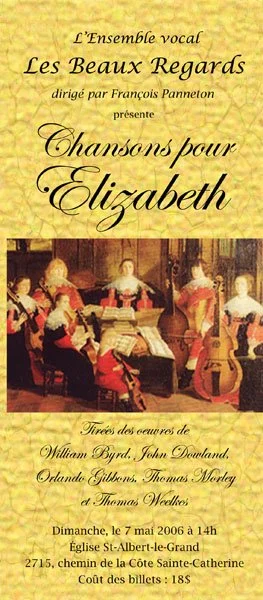
Spring 2006 : Elizabethan Songs
With four viola da gambas.
A program entirely devoted to Elizabethan song presented a considerable challenge for Les Beaux Regards. Indeed, we are far from simple, beautifully accompanied melodies here! Through imitative techniques, the voices answer one another, exchanging words, melodies, and motifs in a remarkable interweaving: this is the polyphonic style. The choir members rose to the challenge brilliantly, performing sparkling English songs by Dowland, Byrd, Morley, Weelkes, Gibbons, and others. At the concert, the presence of four viol players completed the Elizabethan touch, resulting in a truly high-caliber performance.
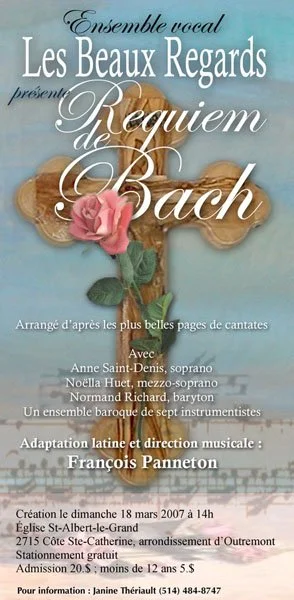
Spring 2007 : A “Bach Requiem”
With 3 soloists, flute, and string orchestra.
On March 18, the vocal ensemble Les Beaux Regards premiered "Bach's Requiem," a grand requiem mass conceived by François Panneton. Within the priceless treasure trove of Bach's two hundred sacred cantatas (all in German), there are several hundred choruses, arias, and duets offering reflections on death. All aspects of the liturgy for the dead are addressed, and the selection is vast: eternal rest, salvation, divine wrath, the yearning for death, the fear of God, the Last Judgment, the vision of Paradise… Our conductor has therefore removed the original German texts and arranged this grand Latin oratorio, primarily choral. The primary aim of this work is to introduce these extraordinary, rarely performed pieces to a wider audience through a coherent composition. The following year, at Productions XXI/21, the Requiem was recorded by an ensemble entirely composed of professionals, Les Agréments de Montréal, conducted by François Panneton.
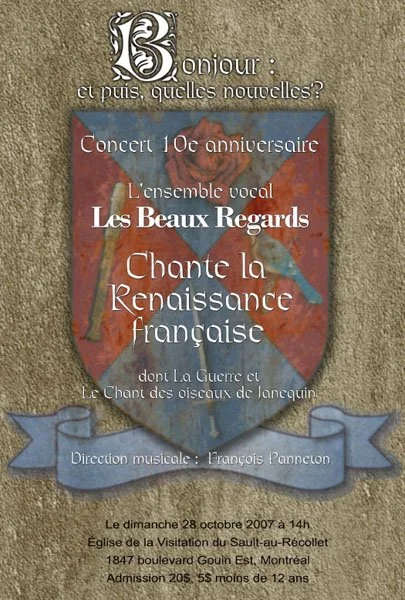
Fall 2007 : The French Renaissance : « Bonjour, quelles nouvelles? »
With four recorders.
To celebrate its 10th anniversary, Les Beaux Regards put together a festive concert entirely dedicated to French Renaissance songs: Sermisy, Janequin, Passereau, Sandrin, and Lassus brought joy to a delighted audience. All former choir members were invited to join the ensemble for the final song.
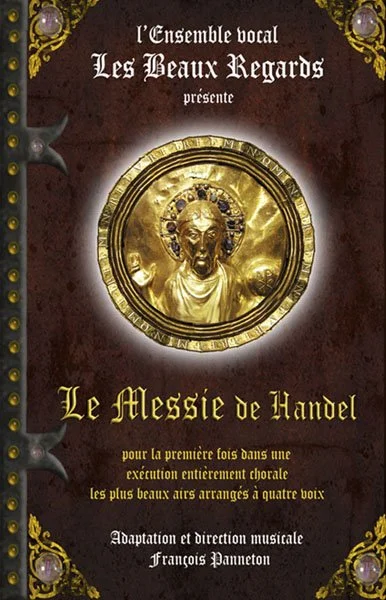
Spring 2009 : Handel, a Choral Messiah
With trumpets and string orchestra.
An original idea from the conductor… What chorister hasn't dreamed of singing Comfort Ye My People, But Who May Abide, He Shall Feed His Flock, The Trumpet Shall Sound—all sublime pieces entrusted to the soloists in Messiah? François Panneton arranged these most beautiful movements for four voices, and the ensemble presented a fully choral Messiah for the first time on April 26, including, of course, the climactic moments of the famous Hallelujah and the final Amen!
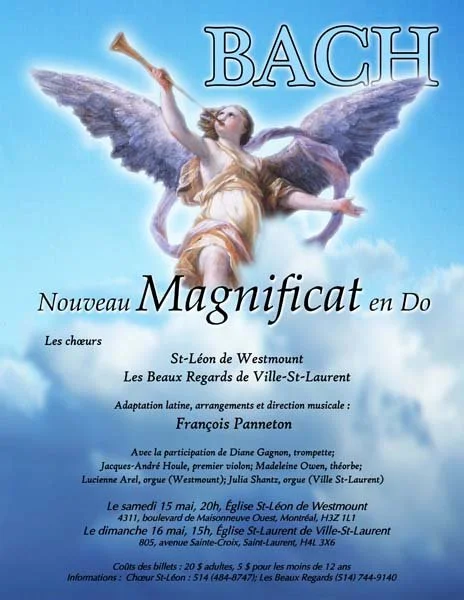
Spring 2010 : Bach, Magnificat
With solo soprano, trumpet, and strings.
That year, the St. Leon Choir of Westmount joined forces with Les Beaux Regards to prepare a Bach concert aturing strings and trumpet. The first half presented the joyous cantata no. 51, Exalt God in all his lands, originally written for trumpet, solo soprano, and strings, in a spectacular arrangement with double choir. The second half featured François Panneton's brand-new 4-voice arrangement of Bach’s Magnificat, also with trumpet and strings. A superb Bach festival!
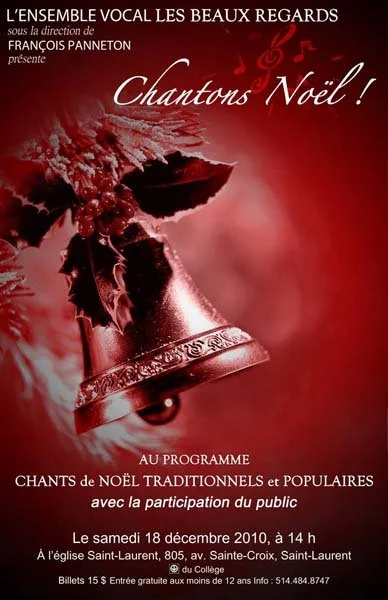
December 2010 : Christmas Songs
A must-see, as listeners were invited to join their voices in the choir. The concert was hailed as one of the most stimulating for the audience, since more than three-quarters of the Christmas carols were sung by everyone.
Spring 2011 : Mozart’s Repentant David
With solo soprano, two clarinets, timpani, and strings.
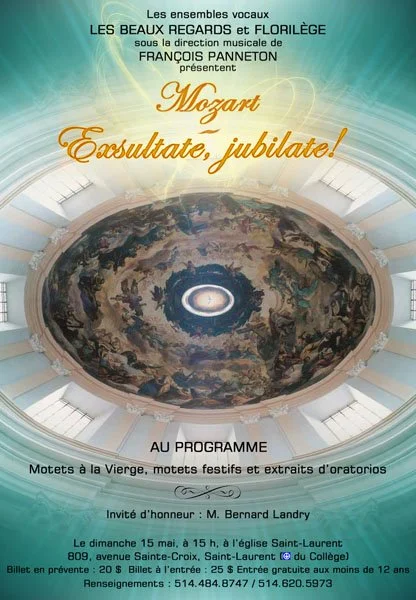
Another collaborative concert: the Florilège Ensemble from Pierrefonds joined forces with Les Beaux Regards for an exploration of Mozart's world. After a selection of sacred music in the first half, the two choirs combined their talents in Mozart's Italian oratorio David Repentant (a work largely based on the music of his great Mass in C minor). The presence of clarinets and timpani enhanced the dramatic character of the work, which concludes with a grand fugue.
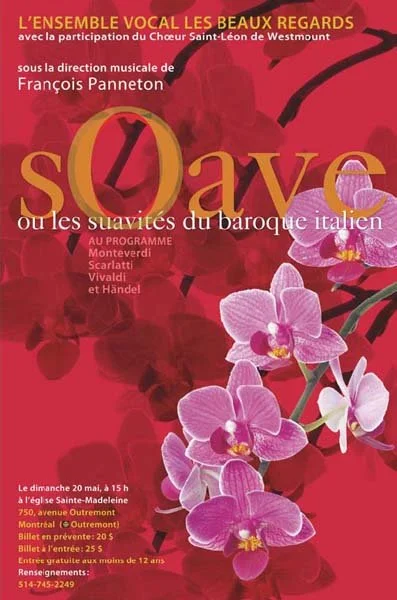
Spring 2012 : The Italian Baroque
With string orchestra.
Have you noticed how many Italian words are still in use among musicians today? Piano, opera, concerto, fortissimo, allegro, solo, crescendo… the list goes on. In the early 1600s, an extraordinary revolution took place in Italian music. In the spring of 2012, Les Beaux Regards presented several gems of Italian Baroque art, drawn from composers who have left their mark on history: Caccini, Monteverdi, Vivaldi, and A. Scarlatti. To this list was added Handel, who spent a large part of his life composing Italian operas… for English audiences!
Spring 2013 : Purcell, Music for a While
With string orchestra.
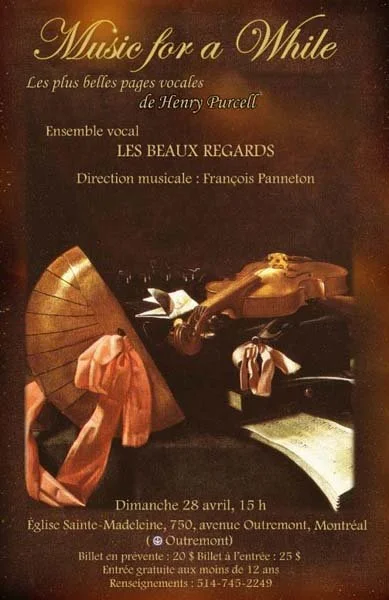
He is spoken of as the greatest English genius in the history of music; he approached perfection in every genre, with fresh and spontaneous inspiration; although he died young (36 years old), the sum of his work is considerable… his name: Henry Purcell. In the first half, Les Beaux Regards presented several famous songs originally written for the theater: If Music Be the Food of Love, Hark All Ye Songsters, Music for a While, Fairest Isle… Then, in the second half, masterpieces of sacred music: Sing Unto the Lord, Rejoice in the Lord Always, Hail Bright Cecilia. An unforgettable concert.
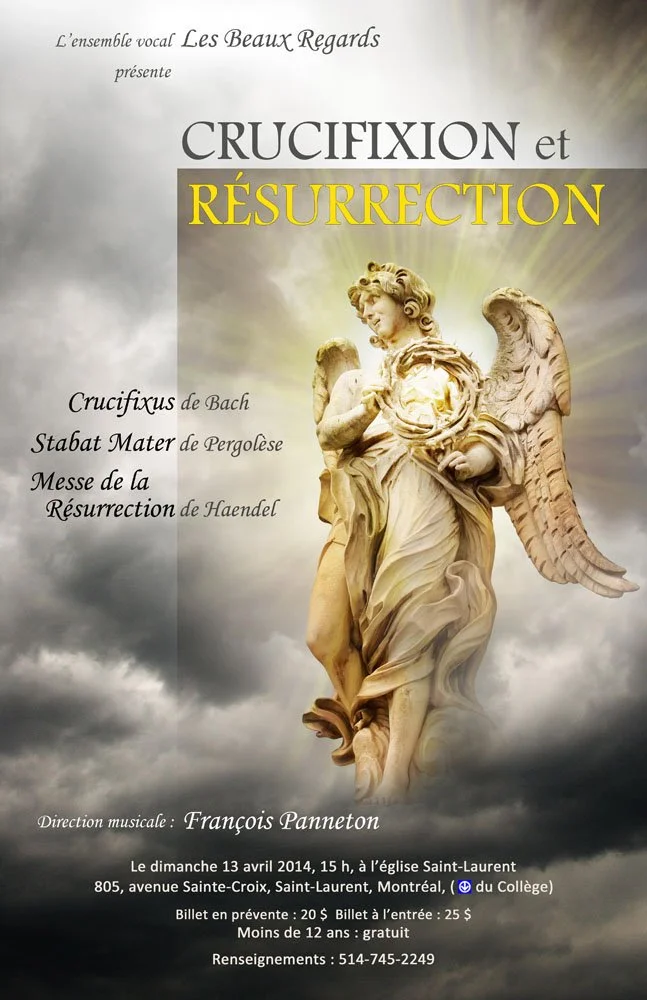
Spring 2014 : Crucifixion and Resurrection (Pergolesi and Handel)
Pergolesi's death at the age of 26 is a tragedy in the history of music. His intense masterpiece, the Stabat Mater, offers a glimpse of the wonders he could have written had he lived. The thirteen movements, originally written for two soloists, were arranged for four voices by conductor François Panneton, in a style that is essentially choral and respectful of the original music. In the second half, the choir presented Handel's Resurrection Mass, again constructed by the conductor from the great master's finest works for trumpet and strings.
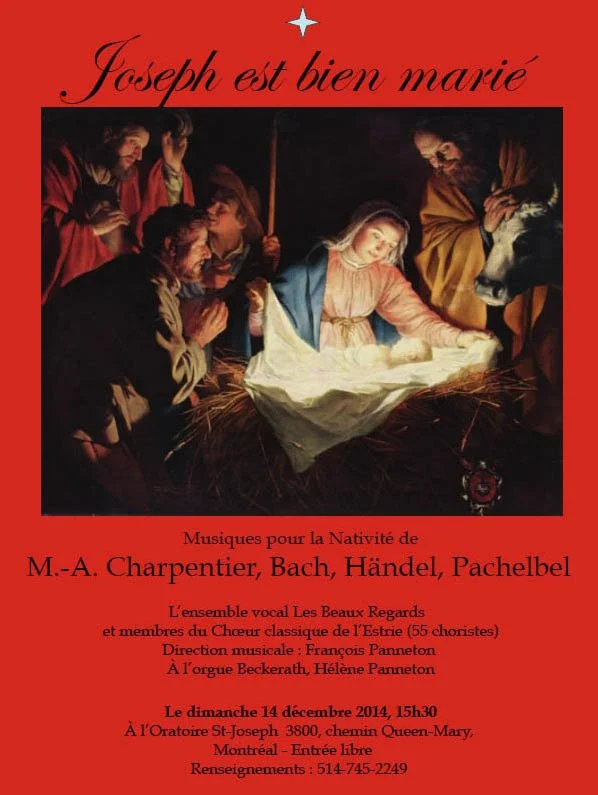
December 2014 : Baroque Christmas
At St. Joseph's Oratory, on Sunday, December 14, 2014, Baroque Christmas carols Joseph is well married (works by M.-A. Charpentier, Bach, Handel, Pachelbel), accompanied on the organ by Hélène Panneton.
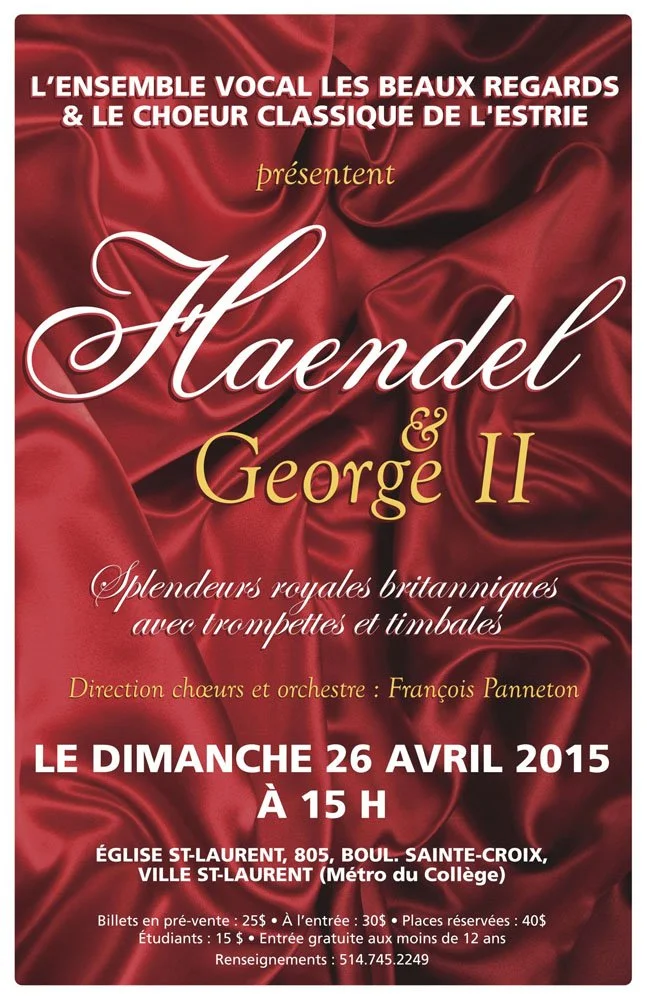
April 2015 : Te Deum
Handel's magnificent Dettingen Te Deum, with three trumpets, timpani and strings, on April 26, 2015, in collaboration with the Chœur classique de l’Estrie (nearly 80 choristers in total).
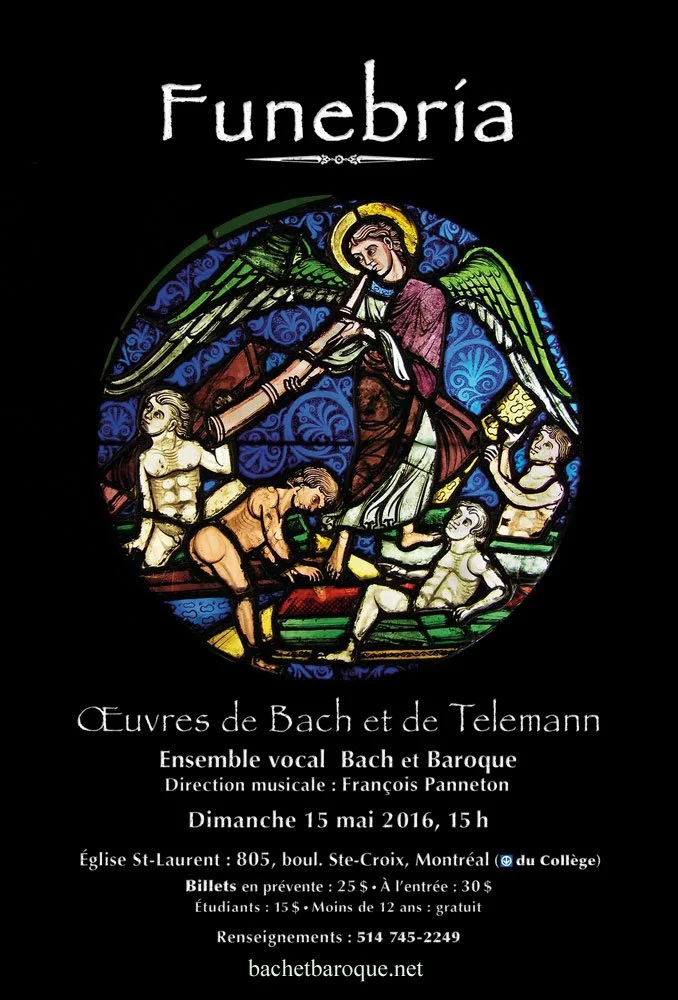
May 2016 : Funebria, Bach and Telemann
Now known as the Bach and Baroque Vocal Ensemble.
With recorders, oboes, viols, cello, double bass, and theorbo, at Saint-Laurent Church on May 15.
Autumn 2016
The Night of Choirs, a first participation, as part of the Bach Festival.
April 2017 : Venise
With Vivaldi, Monteverdi, Albinoni, Lotti and several others, Saint-Laurent Church on April 30th.
November 2017
The Night of Choirs, a second participation, as part of the Bach Festival.
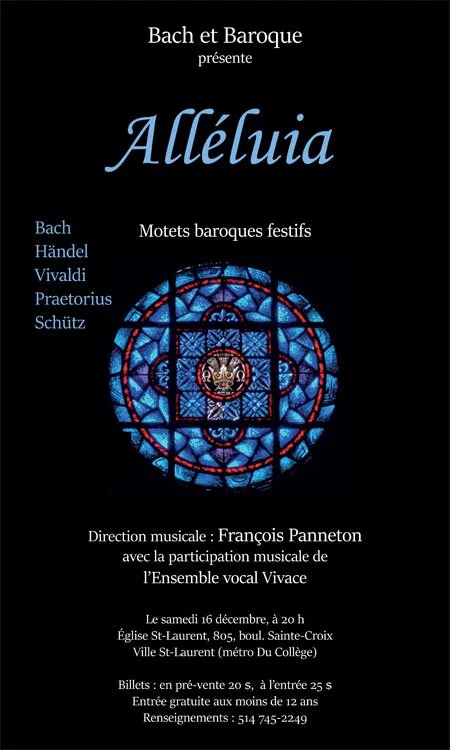
December 2017 : Alleluia
With Bach, Handel, Vivaldi, Praetorius and Schütz, Saint-Laurent Church on December 16th.
November 2018
The Night of Choirs, a third participation, as part of the Bach Festival.
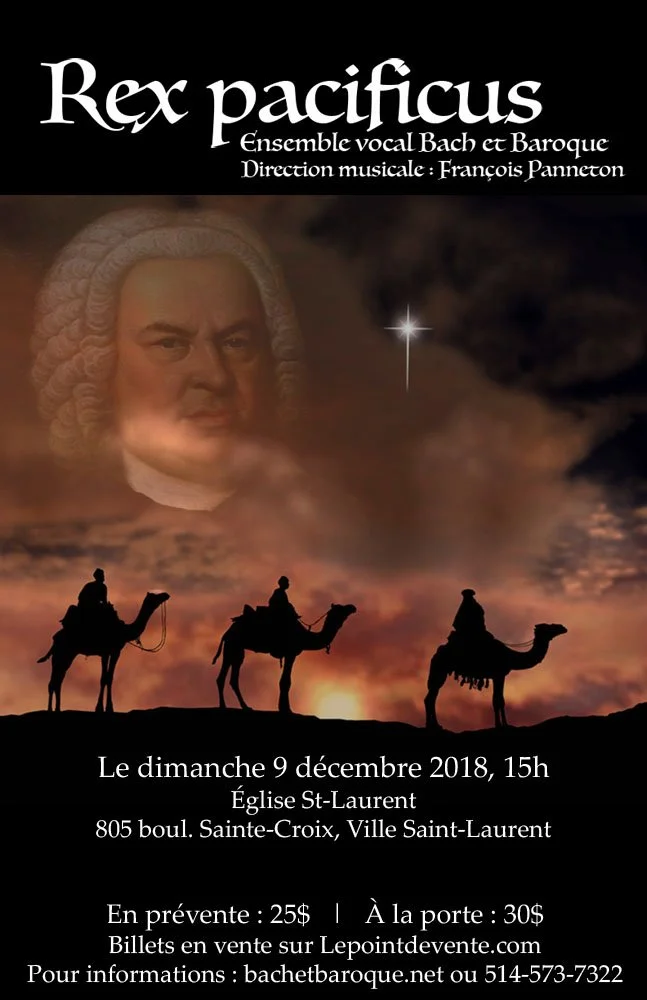
December 2018 : Rex pacificus
A new Bach oratorio, sung in Latin, based on his Christmas cantatas and other festive cantatas.
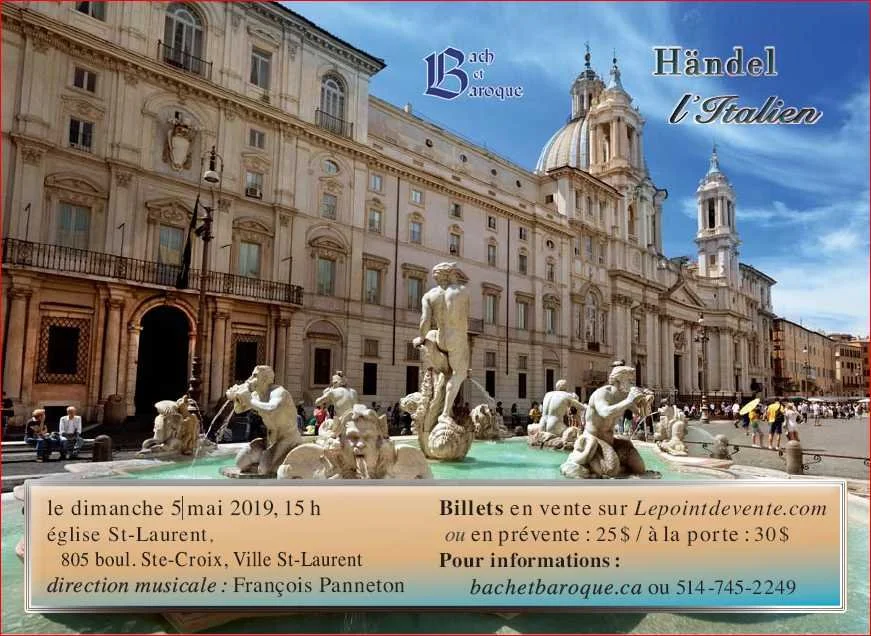
May 2019 : The Italian Handel
A concert of Bach and Baroque music entirely devoted to Handel, more particularly to the most theatrical part of his work: Italian music.
May 2022 : Say Love
A concert largely devoted to the courtly songs of John Dowland (1563-1626), a composer of the Elizabethan era. Among his finest songs composed for four voices and lute are: Come Again, Say Love, O Sweet Woods, Now O Now, Fine Knacks for Ladies... All aspects of courtly love are explored. According to Roland de Candé: "As a lute virtuoso, Dowland was famous throughout Europe... But he also occupied a prominent place as a composer of songs and accompanied melodies. His four songbooks contain masterpieces, and he revealed himself to be a remarkable pioneer." As a complement to the program, the choir also performed some songs by the great master William Byrd (In Fields Abroad, While That the Sun...) as well as some music by Henry Purcell, the most illustrious composer of the English Baroque, a great heir to the Elizabethan song tradition.
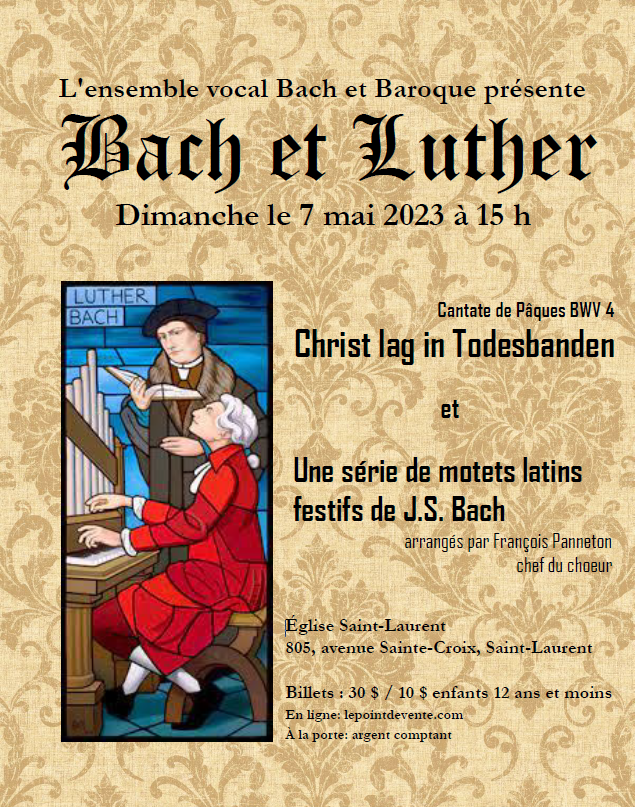
May 2023 : Bach and Luther
At the beginning of the 16th century, the great reformer Martin Luther established congregational singing. He composed some forty of these chorales, and several composers followed his example. As a result, during Bach's lifetime, a corpus of over a thousand chorales was available to Lutheran worshippers! Convinced of the importance of congregational singing for praising the Creator, Bach made extensive use of his favorite chorales when composing the major choral works in his cantatas. The centerpiece of our program, the remarkable Easter cantata BWV 4, Christ lag in Todesbanden (Christ Lay in the Bonds of Death), was based on seven verses by Luther. At the age of 23 when he composed it, Bach had already established himself as the greatest composer of his time: his writing is abundant and of great expressive richness. All movements were performed by the choir.
Under the direction of
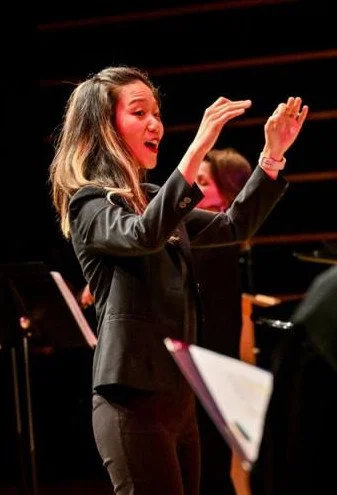
Jennifer Y.M. Lee
since 2023
May 2024 : Laudate Omnes Gentes
With string quintet and theorbo.
Led by its new conductor, Jennifer Y.M. Lee, this concert was offered in homage to François Panneton, founder of the ensemble and choirmaster from 1997 to June 2023. The choir presented several Baroque arias very skillfully arranged by him, as well as two psalms by Vivaldi, and the Short Vespers of Francesco Durante, a somewhat lesser-known composer.
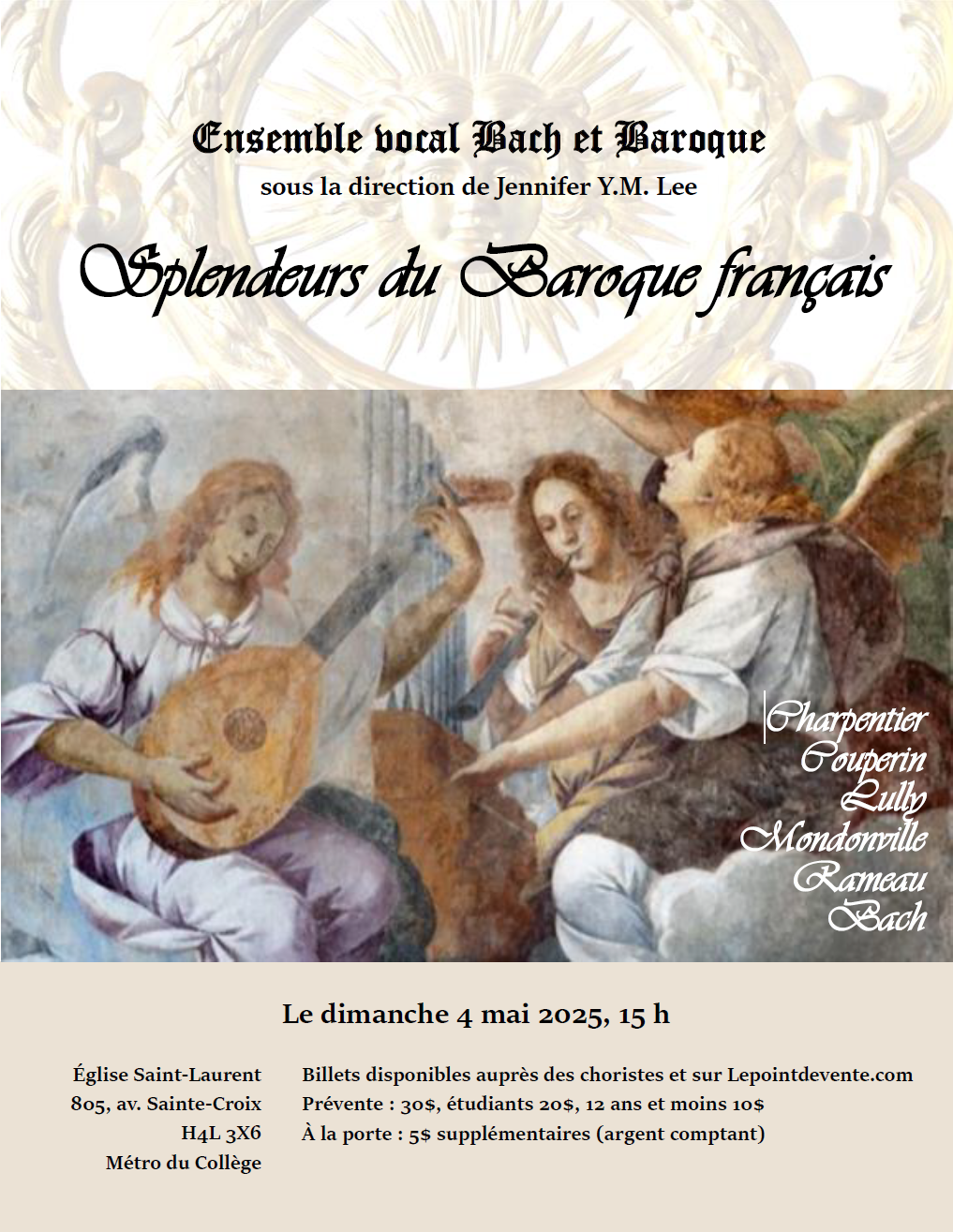
May 2025 : Splendours of the French Baroque
With an orchestra composed of 2 violins, 1 viola, 1 cello, 1 double bass, and 1 theorbo.
As the title suggests, this concert primarily featured works by French composers of the Baroque period. In keeping with the spirit of that era, the Latin texts were pronounced according to the rules of French diction used at the time of the Royal Chapel.
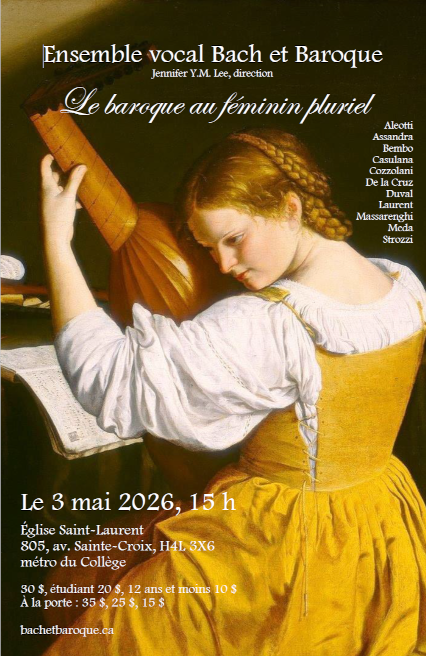
May 2026 : The Feminine Baroque
A unique event on the Montreal musical scene took place on Sunday, May 3rd - an unprecedented concert celebrating thirteen female composers.
Originating from France (Élisabeth-Claude Jacquet de la Guerre, Mademoiselle Laurent, Mademoiselle Duval), Italy (Maddalena Casulana, Chiara Margarita Cozzolani, Vittoria Aleotti, Caterina Assandra, Antonia Bembo, Isabella Leonarda, Paola Massarenghi, Bianca Maria Meda, Barbara Strozzi), and Mexico (Sor Juana Inés de la Cruz), these exceptionally talented women deserve to be known and recognized for their contribution to the enrichment of 17th- and 18th-century Baroque music.
The singers of Ensemble vocal Bach and Baroque were accompanied by seven professional musicians on period instruments.